Pearson Edexcel · GCSE · History
Course version: 1HI0 · Version from Sept 2016
C1000–c1500: Crime and punishment in medieval England - 1 Nature and…
Full specification wording
Option 10: c1000–c1500: Crime and punishment in medieval England - 1 Nature and changing definitions of criminal activity: Changing definitions of crime as a result of the Norman Conquest, including William I’s Forest Laws.
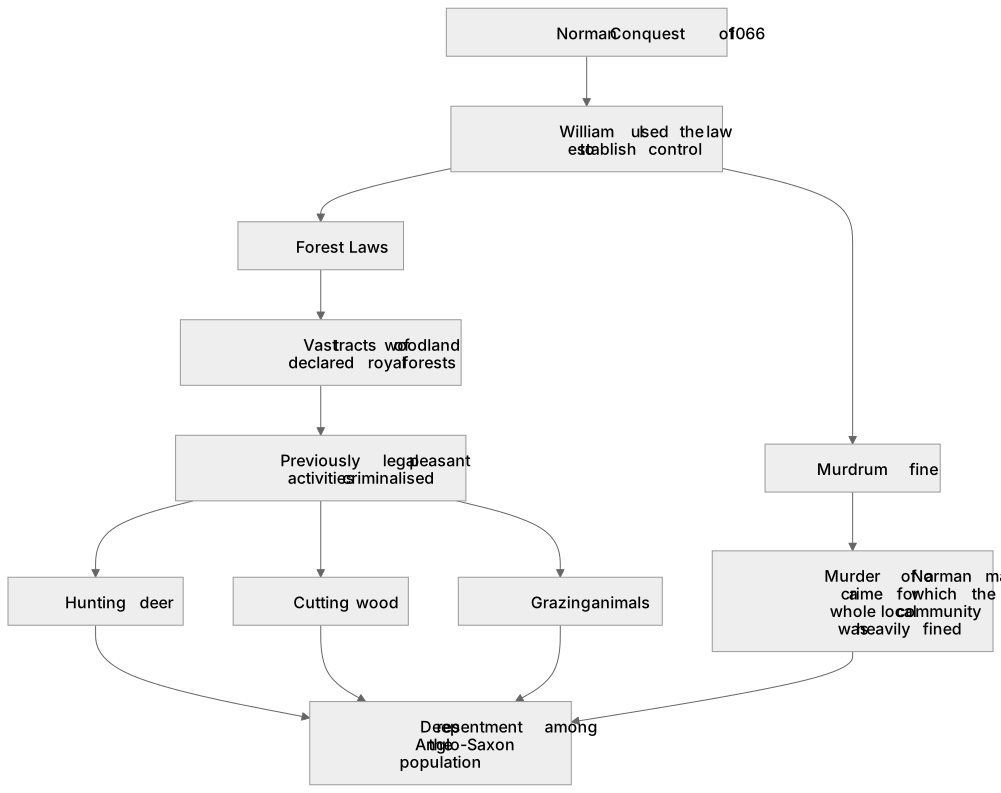
The Norman Conquest of 1066 brought significant changes to the definition of crime, as William I used the law to establish control over a hostile Anglo-Saxon population.
Checked against the Pearson Edexcel 1HI0 specification (opens in a new tab) on .
- Point 2 of 2
- 2 key terms
Study notes
From the checked teaching notes for this specification point.
The idea
The Norman Conquest of 1066 brought significant changes to the definition of crime, as William I used the law to establish control over a hostile Anglo-Saxon population. A major shift was the introduction of the Forest Laws, which declared vast tracts of English woodland as royal forests. This criminalised previously legal activities for peasants, such as hunting deer, cutting wood, or grazing animals. The Forest Laws were deeply resented and transformed everyday survival activities into serious offences against royal authority. Additionally, the Normans introduced the Murdrum fine, which redefined the murder of a Norman as a crime for which the entire local community was heavily fined, reinforcing Norman dominance.
What earns the marks
- Explain that the Norman Conquest led to laws designed to protect the new Norman ruling class.
- Describe the Forest Laws and how they changed the definition of crime by criminalising traditional peasant rights.
- Identify specific activities banned by the Forest Laws, such as hunting deer or cutting firewood in royal forests.
- Explain the Murdrum fine as a new definition of crime where the community was held responsible for the murder of a Norman.
- Analyse how these changing definitions of crime increased resentment among the Anglo-Saxon population.
Common mistakes and how to put them right
Claiming the Forest Laws only banned hunting.
Put it right: Note that the Forest Laws also criminalised gathering wood, foraging, and grazing animals in royal forests.
Stating that the Murdrum fine was paid to the victim's family.
Put it right: Explain that the Murdrum fine was paid directly to the King, unlike the Saxon Wergild.
Assuming crime definitions remained static after 1066.
Put it right: Emphasise that William I actively changed definitions of crime to assert his authority and raise revenue.
Exam tips
- Use the Forest Laws as a prime example of how a change in government (the Norman Conquest) directly changes what is defined as a crime.
- Link the introduction of new crimes to William I's need to control a rebellious Anglo-Saxon population.
- Contrast the Norman approach to crime with the previous Anglo-Saxon system to highlight the changes.
Try the lesson
The start of the Option 10: c1000–c1500: Crime and punishment in medieval England - 1 Nature and changing definitions of criminal activity: Changing definitions of crime as a result of the Norman Conquest, including William I’s Forest Laws. lesson, made from checked teaching notes for this specification point.
Have a go first
What was the primary purpose of the Forest Laws introduced by William I after the Norman Conquest?
Listen
The Norman Conquest of 1066 brought significant changes to the definition of crime, as William I used the law to establish control over a hostile Anglo-Saxon population. A major shift was the introduction of the Forest Laws, which declared vast tracts of English woodland as royal forests. This criminalised previously legal activities for peasants, such as hunting deer, cutting wood, or grazing animals. The Forest Laws were deeply resented and transformed everyday survival activities into serious offences against royal authority. Additionally, the Normans introduced the Murdrum fine, which redefined the murder of a Norman as a crime for which the entire local community was heavily fined, reinforcing Norman dominance. A strong answer earns marks for these points. Explain that the Norman Conquest led to laws designed to protect the new Norman ruling class. Describe the Forest Laws and how they changed the definition of crime by criminalising traditional peasant rights. Identify specific activities banned by the Forest Laws, such as hunting deer or cutting firewood in royal forests. Explain the Murdrum fine as a new definition of crime where the community was held responsible for the murder of a Norman. A common slip: Claiming the Forest Laws only banned hunting. Instead, Note that the Forest Laws also criminalised gathering wood, foraging, and grazing animals in royal forests. Exam tip: Use the Forest Laws as a prime example of how a change in government (the Norman Conquest) directly changes what is defined as a crime.
See it
Key words
Say what each word means before you turn the card.
Forest Laws
Try answering aloud or in your head before turning the card.
Murdrum fine
Try answering aloud or in your head before turning the card.
See every definition
- Forest Laws
- These declared vast tracts of English woodland as royal forests, criminalising previously legal activities for peasants such as hunting deer, cutting wood or grazing animals.
- Murdrum fine
- This redefined the murder of a Norman as a crime for which the entire local community was heavily fined, reinforcing Norman dominance.
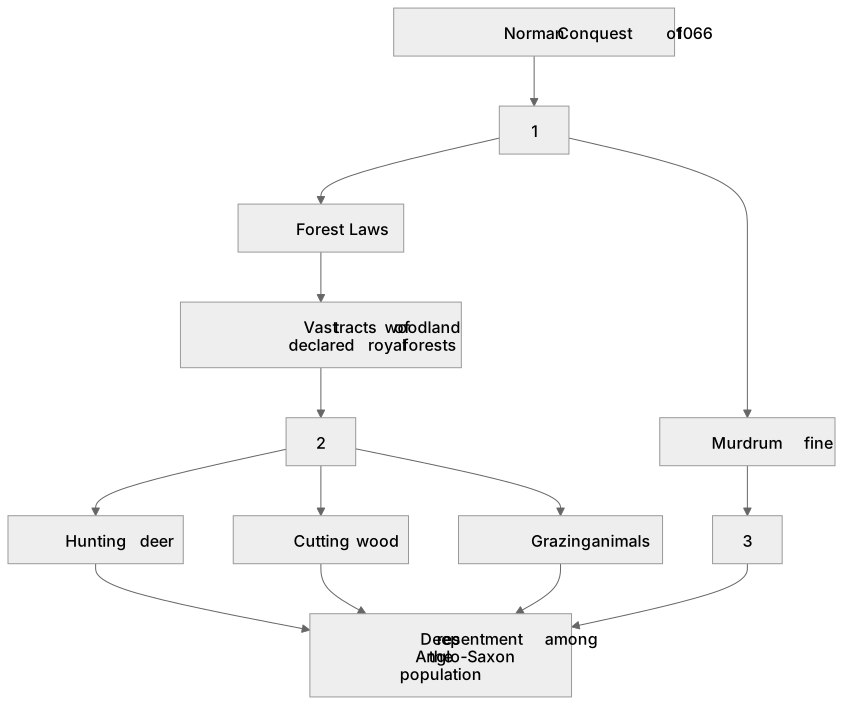
Label the diagram
Some boxes have lost their names. Pick the right name for each number.
1Box 1
2Box 2
3Box 3
There is more to this lesson
The full lesson goes on to check your understanding and help you earn the marks. Create a free account to carry on, with your progress saved.
A week of Premium from your first lesson · Then the free plan continues · No card, no charge
Test your understanding of Option 10: c1000–c1500: Crime and punishment in medieval England - 1 Nature and changing definitions of criminal activity: Changing definitions of crime as a result of the Norman Conquest, including William I’s Forest Laws.
Active recall beats re-reading. Take an instant quiz now to test what you’ve learned and lock it into long-term memory.
A week of Premium from your first lesson · Then the free plan continues · No card, no charge